

| TL;DR The aged inventory surcharge jumps from $1.50 to $5.45 per cubic foot between the 241-270 and 271-300 day bands.Q4 base storage is about 3.1× the rest of the year for standard size: $0.78 rising to $2.40 per cubic foot.The surcharge starts at 181 days, and Amazon takes its measurement on the 15th of each month.A slow-moving example costs $238.45 a month against $17.55 for the same product moving quickly.Short version: storage is not a flat overhead, it is a penalty schedule with a cliff in it, and the cliff falls between day 270 and day 271. |
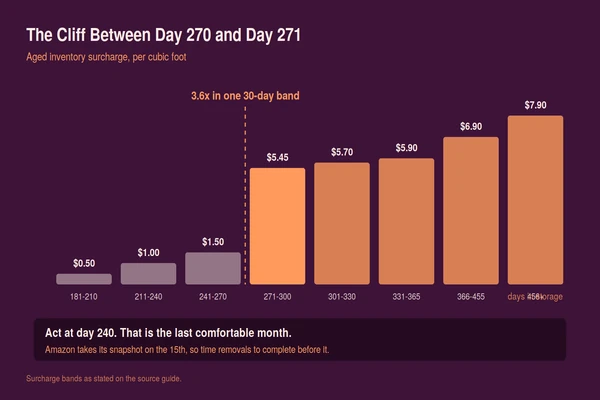
Most fee schedules escalate. This one has a step in it, and the step is a factor of 3.6.
Inventory sitting 241 to 270 days attracts $1.50 per cubic foot. At 271 to 300 days it attracts $5.45. Nothing about the units changed on day 271. They aged by twenty-four hours.
The full rate tables and the planning inputs are set out in this Amazon storage fee calculator guide.
The Aged Inventory Schedule
The surcharge begins at 181 days and climbs through eight bands.
| Days in storage | Surcharge per cubic foot |
| 181 to 210 | $0.50 |
| 211 to 240 | $1.00 |
| 241 to 270 | $1.50 |
| 271 to 300 | $5.45 |
| 301 to 330 | $5.70 |
| 331 to 365 | $5.90 |
| 366 to 455 | $6.90, or $0.30 per unit if greater |
| 456+ | $7.90, or $0.35 per unit if greater |
Three modest bands, then a step of 3.6x in a single thirty-day window.
The first three bands are a nudge. The fourth is a decision being made for you.
Which is why the operationally useful number is not 181 and not 365. It is day 240, because that is the last comfortable moment to act. Inventory approaching 240 days has roughly a month before it becomes expensive to hold and starts to justify a removal, a liquidation, or a price cut you would not otherwise make.
Q4 Costs Three Times More
The base rate has a seasonal shape that works directly against how inventory behaves.
| Size group | January to September | October to December |
| Standard | $0.78 per cubic foot | $2.40 per cubic foot |
| Oversize | $0.56 per cubic foot | $1.40 per cubic foot |
That is about 3.1× for standard size and 2.5× for oversize, applied in exactly the quarter when sellers hold the most stock.
The planning consequence is not to hold less inventory in Q4, which would be the wrong lesson and would cost you the season. It is that Q4 inventory needs to be sized against a rate three times higher, so the cost of overshooting your forecast in October is three times the cost of overshooting it in March. Q4 rewards accuracy more than any other quarter, and the penalty is asymmetric.
The Surcharge Most Sellers Have Not Heard Of
There is a third charge on top of base and aged, and it is levied on the shape of your inventory rather than its age.
The storage utilization surcharge applies when average daily inventory volume for a size group reaches at least 25 cubic feet and the storage utilization ratio exceeds 22 weeks. It then scales by band, from $0.44 per cubic foot at 22 to 28 weeks up to $1.88 at 52 weeks and beyond for standard size.
The ratio is weeks of cover: how much inventory volume you hold relative to how fast you ship it. Twenty-two weeks means you are carrying roughly five months of stock. Its inverse is the sell-through rate, which Amazon computes as units shipped in the past 90 days divided by average units on hand over that period, so the two describe the same thing from opposite ends. Either way it is a forecasting quality charge more than a storage charge.
Two exclusions worth knowing. It requires a Professional account and applies only where your first US FBA shipment was received more than 365 days ago, so new sellers are outside it. And it looks at inventory aged more than 30 days, so recent arrivals do not count against you.
The Snapshot Is on the 15th
One operational detail that turns all of the above into something you can actually manage.
Amazon assesses the fee using an inventory snapshot on the fifteenth of each month. Not the end, not an average across the period. One day.
That makes removals and liquidations a timing decision rather than a general intention. A removal that completes on the 14th is a removal that saves you the month. The same removal completing on the 16th does not, and the difference on aged stock in the $5.45 band is real money for no additional work.
What Slow Actually Costs
The destination page runs one product at three velocities, and the spread is the argument.
| Monthly sales | Base storage | Aged surcharge | Total |
| 100 units | $17.55 | $0.00 | $17.55 |
| 50 units | $35.10 | $0.00 | $35.10 |
| 20 units | $109.62 | $128.83 | $238.45 |
Halving the sales rate from 100 to 50 doubles the base cost, which is intuitive: the same stock sits twice as long. Cutting velocity again to 20 units multiplies the total by nearly seven, which is not intuitive, and it happens for two reasons stacked on each other. Base storage rises faster than proportionally because inventory accumulates rather than merely lingering, and the stock crosses into the aged bands and picks up a second charge that did not exist at all in the first two rows.
On a 300-unit receipt, that slow scenario works out at roughly $0.79 of storage per unit received, and that figure is worth carrying into a sourcing model. A product with a thin margin and an uncertain velocity is carrying a cost that only shows up if the velocity assumption is wrong, which is precisely when you can least afford it.
The Accounting Side of Stock That Stops Moving
There is a parallel to all this that sits outside the fee schedule and is worth knowing about.
When goods genuinely stop being salable at normal prices, the tax rules on inventory valuation recognize it. 26 CFR § 1.471-2(c) provides that goods “unsalable at normal prices or unusable in the normal way because of damage, imperfections, shop wear, changes of style, odd or broken lots, or other similar causes” should be valued at “bona fide selling prices less direct cost of disposition.”
Read that list carefully, because it is about the condition of the goods and not about how fast they are selling. “Changes of style” and “odd or broken lots” describe some aged Amazon inventory accurately. Stock that is simply slow, in perfect condition and still current, is not on the list, and courts have been clear that excess inventory cannot be written below cost merely because there is too much of it.
The regulation then attaches a condition that is the practical point here: bona fide selling price “means actual offering of goods during a period ending not later than 30 days after inventory date,” and “the burden of proof will rest upon the taxpayer.”
So you cannot mark it down on the basis that nobody wants it. You have to have genuinely offered it at the lower price, within the window, and you have to keep the records showing what happened. That is a reason to run the discount and document it rather than to leave the stock sitting, and it happens to point in the same direction as the fee schedule.
None of this is tax advice, and inventory method matters a great deal here, including whether you are on LIFO. It is the language in the regulation, and it is worth raising with whoever does your books before the stock hits 271 days rather than after.
Two Reminders, One Calendar
The whole of this article reduces to two recurring tasks.
Pull an inventory age report monthly and look for anything approaching 240 days. That is your action window, and acting inside it is the difference between a discount and a $5.45 surcharge.
And schedule any removal or liquidation to complete before the 15th. It costs nothing to time it correctly and it saves a full month of whatever band that stock currently sits in.
 E-Globe Business