
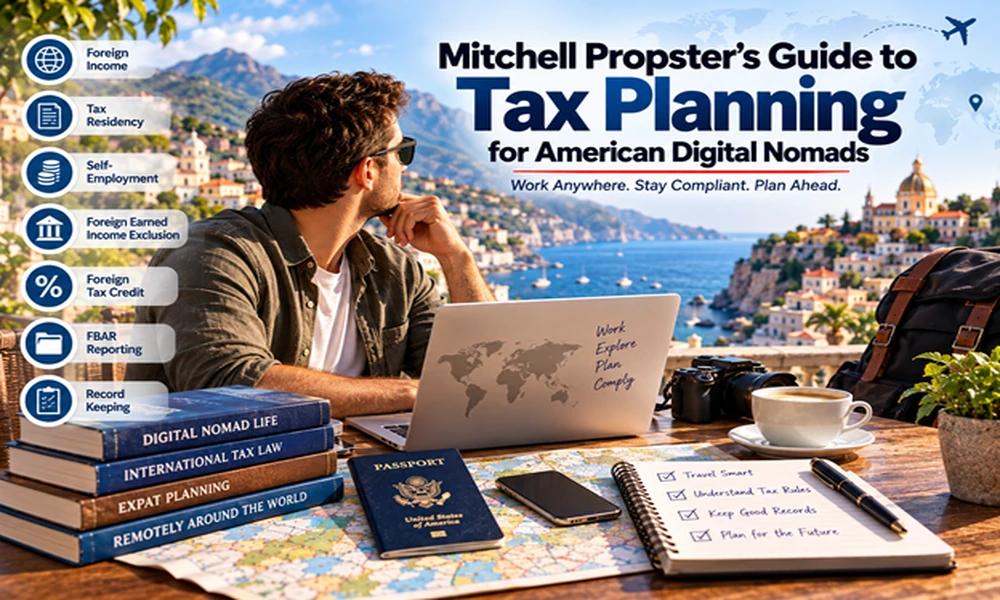
The rise of remote work has made it possible for many Americans to build careers while living outside the United States. Digital nomads may work from apartments in different countries, travel between destinations or operate businesses while spending extended periods overseas. Although this lifestyle can offer considerable flexibility, it can also create questions about U.S. tax filing, foreign income, residency, financial accounts and record keeping.
For American digital nomads, moving between countries does not automatically remove U.S. tax responsibilities. U.S. citizens and resident aliens living abroad are generally subject to U.S. federal income tax on their worldwide income. Understanding how the rules apply to a particular situation is therefore an important part of managing an international lifestyle.
Moving Between Countries and Tax Residency
One of the most important considerations for a digital nomad is understanding where they are considered resident for tax purposes. Spending time in several countries does not necessarily mean that a person has the same tax status everywhere.
Each country has its own rules for determining tax residency. Factors can include the amount of time spent in the country, permanent or habitual residence, employment or business activities and other connections. Tax treaties can also affect how residency and income are treated in particular circumstances.
For U.S. purposes, the concept of a foreign tax home can also become relevant when considering the Foreign Earned Income Exclusion. The IRS explains that a taxpayer generally needs a tax home in a foreign country and must satisfy either the bona fide residence test or the physical presence test to qualify for the exclusion.
Digital nomads who regularly move from one country to another should therefore avoid assuming that simply spending a certain number of days overseas automatically determines their complete tax position.
Understanding Foreign Income
American digital nomads can receive income in many different ways. They might work as employees, operate freelance businesses, provide professional services, receive consulting fees or run an online company.
For U.S. tax purposes, the location of the bank account receiving payment does not necessarily determine where earned income comes from. The IRS explains that the source of income from personal services is generally the place where those services are performed.
This makes record keeping particularly important for people who work while travelling. Maintaining information about where work was performed, when it was performed and how income was received can help establish an accurate record for tax reporting.
Self Employment Can Add Another Layer
Many digital nomads work independently rather than as traditional employees. Freelancers, consultants, designers, developers and other independent professionals may need to consider both income tax and self employment tax rules.
Operating a business internationally can also introduce additional questions involving business structure, foreign entities, local registrations and reporting obligations. The appropriate treatment depends on the individual’s circumstances and the countries involved.
For that reason, digital nomads should distinguish between simply earning income while travelling and formally establishing a business or other economic presence in another country.
Foreign Earned Income Exclusion
The Foreign Earned Income Exclusion is one of the U.S. tax provisions frequently considered by Americans working abroad. If the applicable requirements are satisfied, a qualifying taxpayer may be able to exclude a portion of foreign earned income from U.S. federal income tax.
However, the exclusion is not automatic merely because someone works outside the United States. The IRS states that taxpayers generally need a foreign tax home and must satisfy either the bona fide residence test or the physical presence test. Under the physical presence test, a qualifying taxpayer generally needs to be physically present in a foreign country or countries for at least 330 full days during a qualifying 12 month period.
This can be particularly important for digital nomads because frequent travel may make it difficult to satisfy the requirements in a straightforward way.
The exclusion also applies to qualifying foreign earned income rather than every form of foreign income. Investment income, for example, is not transformed into earned income simply because an individual lives abroad.
Foreign Tax Credit
The Foreign Tax Credit is another provision that may be relevant when an American pays qualifying income taxes to another country. In appropriate circumstances, the credit can reduce U.S. tax on income that has also been subject to foreign taxation.
The Foreign Tax Credit and Foreign Earned Income Exclusion are separate mechanisms, and the rules governing their interaction can be important. The IRS states that taxpayers generally cannot claim a foreign tax credit or deduction for foreign taxes paid on income that has been excluded under the Foreign Earned Income Exclusion.
Consequently, digital nomads should not assume that every foreign tax payment automatically produces a U.S. tax credit or that the same income can receive multiple forms of relief.
Foreign Accounts and FBAR
Living internationally can also mean maintaining foreign bank and investment accounts. Certain U.S. persons with qualifying foreign financial accounts may have an FBAR reporting obligation when the aggregate value of those accounts exceeds the applicable threshold.
This means that digital nomads should keep track of foreign checking accounts, savings accounts and other potentially reportable financial accounts throughout the year. FBAR reporting is separate from the ordinary federal income tax return, and other international reporting requirements may also apply depending on the taxpayer’s assets and circumstances.
Keeping account statements and maximum balance information throughout the year can make it easier to determine whether reporting requirements apply.
Record Keeping Is Essential
For someone who changes countries regularly, good records can be especially valuable. A digital nomad may want to maintain travel dates, accommodation records, employment or client information, invoices, bank statements, foreign tax documents and currency conversion records.
These documents can help establish where work was performed, how much income was received and what foreign taxes were paid. They can also provide useful evidence when determining whether a taxpayer meets particular residency or presence requirements.
Mitchell Propster and International Tax Planning
Mitchell Propster is associated with Expat Tax Firm, a firm focused on tax matters affecting Americans living and working internationally. The firm’s services address areas of U.S. expat taxation and international tax compliance, making the field relevant to mobile workers who need to consider U.S. requirements alongside their activities abroad.
Information about international tax services can be found through Expat Tax Firm, while Mitchell Propster’s professional information is available through his LinkedIn profile.
The broader value of international tax planning is that it encourages taxpayers to consider their circumstances before filing deadlines arrive. For digital nomads, this can mean reviewing travel patterns, income sources, business activities, foreign accounts and applicable tax rules throughout the year rather than trying to reconstruct everything afterward.
Planning for a Mobile Lifestyle
Digital nomadism can make tax matters more complicated because the taxpayer’s location, income sources and financial arrangements may change frequently. A person who spends several months in one country and then moves elsewhere may face different local rules from someone who establishes a long term residence in a single jurisdiction.
There is no universal tax approach for every digital nomad. The appropriate treatment depends on factors such as citizenship, tax residency, type of income, business structure, foreign taxes and financial accounts.
For Americans working around the world, understanding these factors early can make it easier to organize records and identify questions that require professional attention. International tax planning is ultimately about understanding the rules that apply to an individual’s circumstances rather than assuming that living abroad creates a single standard tax outcome.

