
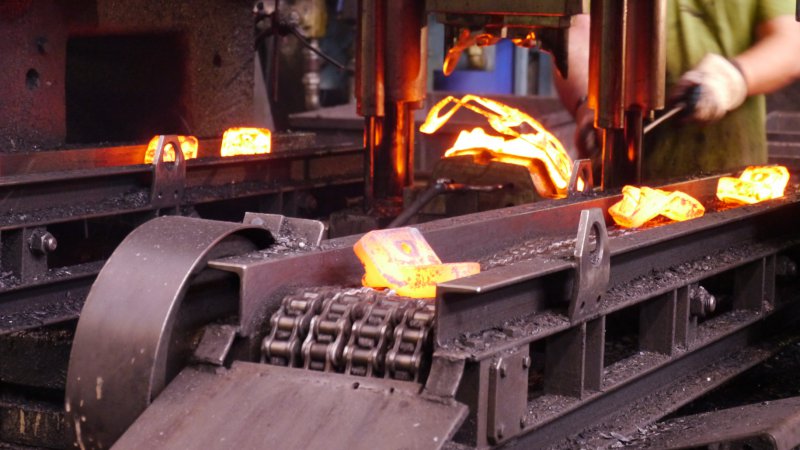
A metal workpiece is heated throughout the forging process until it becomes malleable and easy to shape. The metal is then formed into its final shape during manufacture using heat and compression. By utilising a variety of different procedures, open and closed die forging enables the metal to assume a new shape. In the past, hot steel or iron was shaped by being hammered on an anvil. As technology developed, power hammers were commonly employed, but dies and presses gradually replaced them.
On the other hand, computer numerical control or CNC machining services is a computerised process in which metal is fed into a cutting tool. A revolving cutter eliminates extra material to produce the correct form after sensors in the machine assist in identifying where to place the metal. This process produces smooth curves since it is fully automated and controlled via a computer interface.
CNC machining services are an additive manufacturing technique, while machining, like all other types of machining, is a subtractive one. In contrast, forging entails applying force to a piece of raw material to bend it into the required shape, while machining generates components by removing extra material.
Advantages and Disadvantages of Closed Die Forging and CNC Machining Services
The following advantages and disadvantages of both forging and CNC will help you choose the right process depending on your needs:
CNC Machining Services
Advantages
CNC machining services are perfect for producing items with complicated geometry, such as acute angles. CNC machining is the way to go, whether you’re interested in mass manufacturing a range of various designs or if you simply want to create something once. With the use of CNC equipment, forging dies for hammers and horizontal upsetters are also produced. The CNC software is preserved as soon as the production-tested dies have been utilised so that it may be used later to re-cut the same dies when they ultimately wear out or to make new products with a similar structure using some of the routine modules. Compared to cast or forged components, CNC-machined goods often offer greater quality and more uniform surface finishes.
Disadvantages
CNC machining takes time into account. In comparison to forging, it also slows down the fabrication of simple components. The primary cost generator is waste creation. Metal shavings produced by each manufacturer are useless as anything other than junk. So, if you produce a lot of intricate items and discard a lot of the leftovers, your production costs will rise fast.
The complex machines that use computer numerical control technology include several motors and moving parts. As a consequence, costs related to operation and maintenance—such as oiling and standard repairs—will increase.
Closed Die Forging
Advantages
Depending on the size and planned usage of the item, closed die forging metal components may result in an improvement in their strength and lifespan over machining. Forging techniques like drop or upset forging, for instance, concentrate on forming solid metal parts while preserving and enhancing the grain structures to improve the part’s durability and integrity.
As a consequence, forded components are ideal for high-stress applications. Forded bolts with a hexagonal or head form, for instance, are put through a great deal of stress and strain over the course of their useful life; as a result, they need to be exceptionally robust and ductile. However, casting or machining techniques cannot provide the desired grain structure.
Disadvantages
The high entry barrier for forging also includes the cost of necessary tools. In contrast to CNC machining services, which may be done using a computer-generated model, hot-forded items produced using the hammer and die technique need that the moulds be accurately formed beforehand. Die designs may now be simulated on a computer so that they work flawlessly the first time they are placed into a hammer, saving time and effort in future efforts.
A forded component’s surface treatment might potentially be troublesome. Or, to put it another way, forded parts have visible flaws. The surface is often uneven and far from the polished quality that may be produced by machining. This is usually not an issue when forged components are required. However, in circumstances where exact tolerances are crucial, further finishing will be required and more costly. The potential of forging is also limited by the size of the object being formed and by how easily it can be handled by the hammer or horizontal upsetter.
Choosing Between Forged Components and Machine Work
Due to the size of the usual number of runs in Australia, CNC machining services are probably the most practical choice in many situations. Closed die forging, on the other hand, is the best option if you want a stronger and more tactile outcome.
The two procedures work quite well together. In order to impart the strength attributes, open and closed die forging is often utilised. After that, CNC is used as a finishing process, generating high levels of precision and surface polish that further boost the completed components’ fatigue life and durability.
Meta Description
Know the advantage and disadvantages of closed die forging and CNC machining services now when you read the in-depth comparison of them for proper utilisation.
 E-Globe Business