
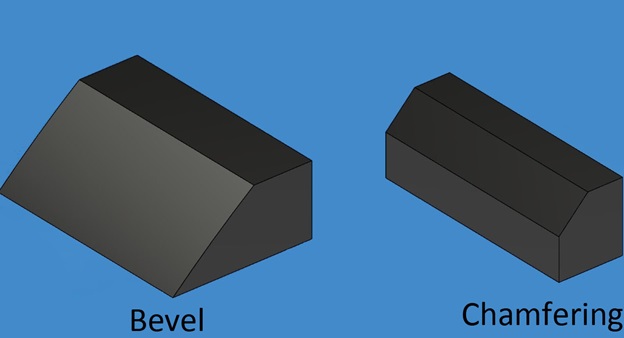
Are you unsure of the difference between a chamfer and bevel? If so, you’re not alone! Although the two terms are often used interchangeably, they are actually quite different. A bevel is an angled surface that is created by removing material from the edge of an object, while a chamfer is a beveled edge that has been smoothed and rounded off. In this blog post, we’ll discuss the differences between a bevel and a chamfer in more detail.
Do you know the difference between a chamfer and a bevel? Many people don’t, but it’s an important distinction to understand when working with precision machined parts. A chamfer is an angled surface that is used to reduce a sharp edge, while a bevel is an angled surface that is created to join two surfaces at an angle. Both chamfers and bevels are used in the manufacturing of precision machined parts, but they are not interchangeable.
The basics of beveling
Beveling is a machining process used to create angled edges or surfaces on a part or component. It is typically done using special tools that are designed to cut along an angle, producing a beveled edge. Beveling can be performed on metals, plastics, and other materials, and is often used for finishing purposes, such as when creating parts for automotive and aerospace industries.
Beveling creates angles that are typically greater than 45 degrees, which gives the finished edge a slanted appearance. This makes it ideal for parts and components that require a non-uniform surface with distinct edges. Beveling can also be used to create aesthetic designs, such as decorative patterns or shapes.
The tools used for beveling can vary depending on the material being worked on and the desired outcome of the project. Generally, they involve milling tools, cutting tools, grinding tools, or other abrasive tools. Each of these tools can be adjusted to create different bevel angles and depths.
With the right tools and experience, beveling can provide precision results and give parts and components the desired finish. It’s an important process for creating quality parts and components that meet industry standards.
The basics of chamfering
Chamfering is a machining process that involves removing material from the edges of a workpiece. This is done to create a smooth and consistent surface, as well as to give the piece a more finished look.
Chamfering can be used on both internal and external edges and is often used in combination with other processes such as drilling, reaming, and tapping. In this process, cutting tools such as chamfering cutters are used to create the desired shape and size. These tools typically have several different cutting edges on them and can be used to create either angular or rounded edges.
The most common type of chamfer is the 45-degree chamfer. This angle is created by cutting away an equal amount of material from each side of the edge in order to create a symmetrical angle. The 45-degree angle also creates a strong joint which can be beneficial when working with materials such as metal.
Chamfering is an incredibly important process in many industries, especially those that require high levels of precision such as aerospace, automotive, and medical manufacturing. The process is often used to increase the strength and life of parts, as well as improve their aesthetic appearance.
The differences between beveling and chamfering
Beveling and chamfering are two processes used in precision machined parts manufacturing. Although they appear very similar, there are some distinct differences between the two.
Beveling is a process in which the edges of the material are cut at an angle, creating a slope that changes the shape of the part. This technique can be used to create angled surfaces on a part or to achieve a specific depth when making cuts in the material. Beveling is commonly used for joint preparation and deburring.
Chamfering, on the other hand, is the process of cutting away material at an angle along the edges of a part, usually with a chamfering tool. It is used to create a smoother surface and to remove burrs. This process is also used to reduce stress on the parts by relieving sharp edges and corners.
The main difference between beveling and chamfering is in the shape they produce. While beveling creates a slope that changes the shape of the part, chamfering produces an angled surface along the edge of the part that does not change its shape.
Beveling and chamfering are both important processes used in precision machined parts manufacturing. They both create angles along the edges of the part, but the shape they produce is quite different. Beveling is used to create a sloped edge or cut to achieve a specific depth, while chamfering is used to smooth out sharp edges and reduce stress on the part. Yijin Hardware has extensive experience with both processes and can help you get the results you need.
The benefits of each
Beveling: Beveling is a great way to add texture and dimension to a product, as well as providing a smooth transition from one surface to another. This can create an aesthetically pleasing effect and can also help reduce friction when two surfaces meet.
Chamfering: Chamfering has the same effect as beveling but with a more precise finish. The chamfer’s edge is slightly rounded, which helps reduce stress concentration points, making it an ideal choice for precision parts. It can also help extend the life of a part by preventing wear on edges. Additionally, chamfering allows more flexibility in the design process because of its ability to produce complex contours with ease.
Read More: https://yijinsolution.com/
 E-Globe Business